
Market Volatility and the Case for Diversification

On March 27, the Dow Jones Industrial Average officially entered correction territory (defined as a 10% decline from its peak) on the heels of the military conflict in Iran and the anxiety about the global economy it triggered.
It seems a surprise to many people that well-diversified portfolios have likely held up much better than the Dow in the recent volatility. It’s not hard to understand why: the Dow is the index most everyone looks to when they glance at their phone or TV to see what “the market” is doing any given day. What’s actually going on in the market beyond that iconic index seldom gets much, if any, attention.
It’s worth remembering, therefore, that the Dow reflects only a very specific segment of the equity market: stocks of the 30 largest publicly traded U.S. companies, including the likes of Wal Mart, Coca-Cola and Apple. Even the much broader S&P 500 is still heavily weighted toward the largest of large cap U.S. stocks.
The recent correction in the Dow illustrated the potential benefits of being diversified into other areas of the market; this was observed this quarter in the performance of asset classes such as small value stocks and U.S. REIT stocks:
3-Month Return 1/1/2026 – 3/31/2026
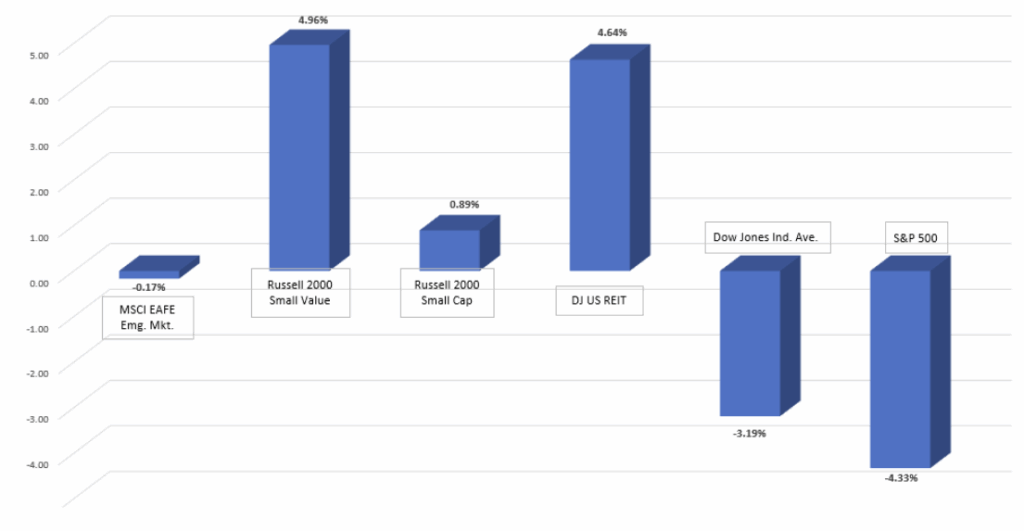
One benefit of the institutional, asset-class funds we use in our portfolio strategies at Savant, is that they can help us to effectively diversify beyond the narrow market segment the Dow encompasses. To be sure, this potential benefit isn’t as evident when well-known large cap stocks lead the market for months or even years. Over the long run, however, including these other asset classes can help provide a buffer when things turn south for the large cap stocks in the Dow and S&P.
There is a reason why large, institutional investors such as public pension funds and endowments make decisions strictly within the framework of their Investment Policy Statements. These statements are the foundation of their investment process and can act as a guardrail against emotion-driven investing. They also establish parameters within which their investment advisors must also operate.
Emotions can run to both extremes in the stock market at different times. Usually, we think of investors being fearful and reactionary in times of extreme volatility in the market, like 2001, 2008 and 2020. But investors can be just as reactionary in the times of “irrational exuberance” like we saw in the late 1990s and again in the mid-2000s. Those types of market environments can be just as tempting to let emotions rule investment decisions.
So, when these large pension and endowment funds create comprehensive investment policies that govern their decision-making, it isn’t just for show, or for legal cover. It’s also to help take the risk of emotional decision-making and bad guessing off the table for the people who make the decisions. Market extremes can be tempting to institutional investors, too. After all, there are still humans behind the institutions, subject to the same emotions we all are.
All of which sums up the exact reason we carefully draft Investment Policy Statements for our clients at Savant Wealth. In fraught times such as we all are experiencing currently – politically, socially, emotionally – the IPS is the North Star both we (as the advisor) and you (as the client) use to navigate such challenging times more thoughtfully.
In a recent interview on CNBC, Warren Buffett had one of his classically pithy takes on the notion that anyone could have some sort of secret, wildly profitable investment strategy that they would then, inexplicably, make available to the investing public.
“The idea that if they had gold in their backyard, they’d come on television and say, ‘here’s where the gold is in my backyard…’” Buffett said, shaking his head.
Leave it to the Oracle of Omaha to sum up in one line what we have been saying in longer form for many years: There is no way around the risk-reward equilibrium in investing. If an investment is reaping outsized rewards beyond what anyone else is achieving, it’s likely they are taking a commensurate amount of risk to get those returns.
Consider the absurdity of the idea: If a person did somehow come up with some magic strategy that let them reap all the upside of stock investing without having to assume the risk that goes with it – why on earth would they ever go public with that secret, much less need to sell it?
The fact that such hucksters still proliferate online and in the financial media tells you two things:
- Despite all evidence to the contrary, many people still desperately want to believe that there is, in fact, such a thing as a free lunch; and
- If those hucksters actually were delivering on that promise, the world would have already beaten a path to their door, and they wouldn’t have to be spending a bunch of that free money marketing their magic strategy.
The pitch may change, but the reality is always the same: If someone is claiming you can get above-market returns with below-market risk – put both hands on your wallet and run for the exit, because if their day of reckoning hasn’t already arrived, it likely one day will.
All of which leads us to sum up with another classic Buffett quote we also love:
“You don’t find out who’s been swimming naked until the tide goes out.”
Historical performance results for investment indices, benchmarks, and/or categories have been provided for general informational/comparison purposes only and generally do not reflect the deduction of transaction and/or custodial charges, the deduction of an investment management fee, nor the impact of taxes, the incurrence of which would have the effect of decreasing historical performance results. It should not be assumed that your account holdings correspond directly to any comparative indices or categories.