
Quality vs. Value: Two Disciplines, One Stronger Portfolio

When investors hear terms like quality and value, they often assume they mean the same thing. After all, both approaches focus on companies with solid fundamentals. But while they overlap in spirit, they reward very different characteristics. Understanding that difference can help explain why both can play an important role in a well-diversified portfolio.
What Do We Mean by “Quality” Investing?
Quality investing focuses on financial strength and consistency. Rather than chasing the fastest growing companies or the cheapest stocks, quality investors look for businesses that demonstrate discipline over time.
These companies tend to share a few common traits:
- Strong balance sheets with manageable debt
- Consistent earnings and cash flow
- High returns on equity
- Management teams with a track record of prudent decision making
Well known examples include firms like Microsoft and Johnson & Johnson, which are profitable, stable, and well-run businesses. The appeal of quality stocks is not flashiness but resilience. Historically, they have tended to hold up better during market stress because they rely less on leverage, speculation, or ideal economic conditions to succeed.
In short, quality rewards discipline. It focuses on companies that can perform across a wide range of market environments, not just when conditions are ideal.
How Value Investing Takes a Different Approach
Value investing looks at the market from another angle. Instead of asking, “Which companies are the strongest?” it asks, “Which companies look inexpensive relative to their fundamentals?”
Value stocks are often businesses that are:
- Trading at lower price-to-earnings or price-to-book ratios‑to‑earnings or price‑to‑book ratios
- Temporarily out of favor with investors
- Facing short-term challenges or uncertainty‑term challenges or uncertainty
These are not necessarily weak companies. In many cases, they are established firms whose stock prices have declined faster than their underlying fundamentals. Value investors believe that, over time, the market will recognize this disconnect and reprice the stock closer to its intrinsic worth.
Where quality emphasizes consistency and value can help reward patience. It relies on recovery rather than steady compounding.
One way to think about the difference between quality and value is through valuation. Growth stocks typically trade at the highest valuations, reflecting expectations for rapid future expansion, while value stocks usually trade at the lowest valuations. Quality stocks tend to fall in between the two, neither the cheapest nor the most expensive.
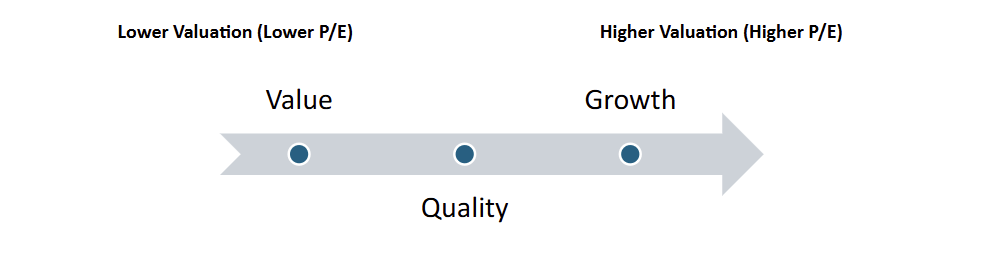
This middle ground reflects what quality represents: companies that may not appear inexpensive but earn their valuation through dependable performance and financial strength.
Why Portfolios Often Use Both
Importantly, quality and value are not competitors. They complement each other.
Quality stocks have historically tended to perform better during periods of uncertainty or market stress when investors place a premium on stability. Value stocks, by contrast, often shine during economic recoveries when improving conditions can help lift undervalued businesses.
By holding both, investors can diversify not only across companies and sectors, but also across different drivers of return. Quality can help anchor a portfolio during volatile periods, while value can provide upside as sentiment improves and prices normalize.
The Takeaway
Quality and value investing share a foundation in fundamentals, but they reward different behaviors. Quality emphasizes resilience, consistency, and financial discipline. Value emphasizes opportunity, patience, and recovery potential.
Because it’s difficult to consistently predict which style will lead in any given market environment, our philosophy emphasizes preparation over prediction. Rather than choosing one approach over the other, many long-term investors benefit from combining both. Quality and value tend to contribute during different market conditions, and together they can help diversify the return drivers within a diversified portfolio. Long‑term investors benefit from combining both.
By blending complementary styles, investors can build portfolios that are better prepared for a wide range of outcomes, a key reason we view diversification as an investor’s ally over the long term.
 Torin E. Kasper
Investment Research Analyst
MS
Torin E. Kasper
Investment Research Analyst
MS