
What Every Professor Should Know About Required Minimum Distributions (RMDs)

With the end of the calendar year on the horizon, planning for required minimum distributions (RMDs) becomes increasingly important. For many university professors, their retirement savings are spread across 403(b), 401(a), IRAs, and other tax-deferred vehicles, which can make income and tax planning more complex than expected.
Universities often provide retirement benefits that differ significantly from those found in the corporate world, making it especially important for faculty to understand how RMDs fit into their financial plan.
Retirees or individuals who have reached the applicable RMD age under current tax law must generally begin taking annual distributions from certain tax-deferred retirement accounts. RMDs ensure that tax-deferred assets are eventually taxed. The resulting income, however, can affect more than your tax bill. Since RMDs result in generating taxable income, this can have implications for the following:
- Tax liability due
- Medicare Part B premiums
- Increasing taxable Social Security benefits
- The impact of adjusted gross income on the availability of certain tax deductions, credits, and tax-related planning opportunities
- Phaseout for senior enhanced deduction
Timing matters as well. An RMD that isn’t taken on time can trigger a 25% excise tax on the shortfall. Under Section 302 of the SECURE 2.0 Act, that penalty may drop to 10% if the missed distribution is corrected within the specified window.
RMD planning doesn’t have to wait until faculty reach the applicable age, which current law sets at 73 for individuals born from 1951 through 1959 and 75 for those born in 1960 or later. Many begin planning years earlier, often while employed. Thoughtful planning coordinates withdrawals across multiple retirement accounts, weighs Roth conversion opportunities before RMDs begin, applies charitable giving strategies such as qualified charitable distributions (QCDs), and manages the long-term tax impact of retirement income.
Required minimum distributions are generally calculated using an IRS-prescribed formula based on account balances and applicable life expectancy tables. This formula is the retirement account balance from December 31st of the prior year divided by the IRS life expectancy factor based on your age.
Basic RMD Formula
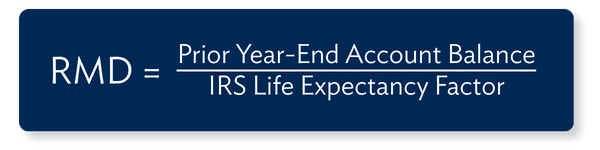
RMD=Prior Year−End Account BalanceIRS Life Expectancy FactorRMD=Prior Year−End Account BalanceIRS Life Expectancy Factor
It is important to understand which IRS table to use when calculating RMDs, since they differ based on situation. Most individuals use the IRS Uniform Lifetime Table, but different tables are used based on spouse’s age.
Now that the RMDs have been calculated, let’s look at common RMD planning and strategies.
RMDs While Still Employed: Faculty who reach RMD age while still working can generally delay RMDs from their current employer’s plan until retirement, provided the plan permits it. This exception doesn’t extend to prior employer plans or IRAs, which still require distributions on schedule.
Some plans allow for the rollover of eligible retirement assets into the active employer plan and postpone RMDs until retirement. It is important to refer to the active employer plan’s specific rollover provisions and eligibility rules to see what options are available.
RMD Aggregation: The IRS allows for aggregation of RMDs for some account types and prohibits it from others. For Traditional, SEP, and SIMPLE IRAs, the RMDs for each account can be calculated and aggregated together to come from any one or combination of IRAs.
Inherited IRAs have different rules. Generally, inherited IRA RMDs cannot be aggregated with the RMDs associated with non-inherited IRAs. Certain inherited IRAs from the same decedent may be aggregated, depending on a range of factors such as beneficiary status.
403(b)s follow similar rules. Faculty calculate the RMD for each 403(b) separately, then aggregate the total from one or more 403(b) accounts. It is important to note that 403(b) withdrawals do not satisfy the RMD for IRAs.
401(k) plans do not allow RMD aggregation. Each plan’s RMD must be taken from that specific 401(k), and an IRA distribution cannot satisfy a 401(k) RMD.
When planning to lump RMDs together, rollovers from previous employer accounts into a rollover IRA may be a useful consideration for some investors, since the retirement assets will already be consolidated in one or multiple IRAs.
Qualified Charitable Distributions (QCDs): For many RMD eligible university faculty, QCDs may offer a tax-efficient way to satisfy RMDs due for IRAs while supporting charities and causes that are important to them. A QCD is a direct transfer from an IRA to a qualified charitable organization. QCDs satisfy the RMD for the IRA and are excluded from the taxable income that would normally be due from an RMD.
QCDs can be made at age 70 ½, must be made from an IRA, and are limited to $111,000 per taxpayer in 2026.
These strategies represent only a few of the planning opportunities available to university faculty and staff approaching or already taking RMDs. Because the right approach depends on an individual’s accounts, income, and goals, faculty should work with a tax professional or financial planner to build a plan suited to their circumstances.
This is intended for informational purposes only. You should not assume that any discussion or information contained in this document serves as the receipt of, or as a substitute for, personalized investment or tax advice from Savant. Please consult your investment or tax professional regarding your unique situation.
 Aaron Y. Dykxhoorn
Financial Advisor
CFP®, MS
Aaron Y. Dykxhoorn
Financial Advisor
CFP®, MS