
How to Avoid Lifestyle Creep

Sustainable financial health often depends on a combination of saving, earning, and spending decision. At a past Berkshire Hathaway annual shareholder meeting, Charlie Munger said, “If you don’t know how to save, I can’t help you.” After a long career that turned him into one of the world’s wealthiest people, Munger believed the most difficult aspect of getting wealthy is saving enough early on to potentially grow it later.
Warren Buffett had an extreme way of looking at it: “Do I really want to spend $300,000 for this haircut?” He knew what the future value of his savings could be, based on his ability to compound his capital. None of us will grow our assets at Buffett’s rate, but viewing a dollar spent today as multiple future dollars is important. “Since Warren looked at every dollar as 10 dollars someday, he wasn’t going to hand over a dollar more than he needed to spend.”
The Millionaire Next Door, and its successor, Stop Acting Rich, set the record straight on who the wealthy are in America. They’re not flashy spenders, but value-oriented savers. Why aren’t more people rich? All too frequently, sufficiently high-income earners prefer to emulate the rich’s spending habits, spending more as their income grows. You can call it ‘keeping up with the Joneses’ or ‘lifestyle creep,’ but whatever you call it, you should avoid this pitfall.
Start by being thoughtful about where you live. The best predictor of consumption is the value of your home (not income or net worth). A bigger home results in a bigger mortgage, a larger property tax bill, larger amounts of money for heating and cooling, more yardage to landscape, and more square footage to maintain.
So far, that’s just proportionate math, but there’s a dangerous dynamic at work that creates exponential problems: Benchmarking yourself against your neighbors and wanting to own the same things they own and spend on the same things they do.
According to The Millionaire Next Door, “when you trade up to a more expensive home, there is pressure for you to spend more on every conceivable product and service…human beings have an innate tendency to act and be like those around them – to fit in – and even to compete.” You’ll trade in your reliable Honda Accord because everyone else drives big SUVs or luxury cars. When the neighborhood kids get pricier toys, your kids will want theirs; your kids will go to more expensive summer camps; they’ll play in pricier sports leagues; you’ll hire hitting coaches for baseball. You might send them to private school with their buddies, even though you first moved to this town for its great public schools. You’ll put in a pool or a nice wine cellar (or both) and join the country club.
Be thoughtful about where you live. The wrong choice can lead to expensive lifestyle creep. How much house is too much? Hint: it’s not what your mortgage broker tells you. Mortgage lenders use a formula to determine loan affordability. The rule of thumb is that your mortgage payment, including real estate taxes and insurance, should not exceed 28% of your monthly gross income. For example, if you’re making $200,000 per year, 28% of your monthly gross income is $4,667. Assuming a 4% interest rate, 1.4% property tax, and 0.20% for insurance, you could afford to buy a $925,000 house and borrow $740,000 after putting down 20%. However, the bank isn’t saying that’s a smart financial planning decision. Lenders use standardized criteria that may not reflect an individual’s broader financial goals, risk tolerance, or long-term plan.
Research from The Millionaire Next Door provides a better answer: “If you’re not yet wealthy, but want to be someday, never purchase a home that requires a mortgage that is more than twice your household’s annual…income.”
To continue the example above, that would mean a home with a maximum mortgage of $400,000 (twice the $200,000 annual salary). Using the same 20% down payment plan, that means a home worth $500,000 instead of $925,000. Your initial down payment would be $85,000 less. Your monthly payments would be $2,493 instead of $4,612, leading to a potential savings of $2,119 (monthly) and $25,428 annually. For example, if incremental savings were invested and earned a hypothetical 5% annual return, net of assumed taxes, the value could grow over time. (And don’t forget about the lifestyle creep!)
We can further this discussion with a hypothetical illustration by comparing two savings and spending plans by similarly situated families (Joe’s and Jim’s). Everything about them is identical (earnings, portfolio returns, ages, income and property tax rates, and savings opportunities), except their personal consumption. This example is simplified and based on assumptions that may not reflect real-world outcomes.
Jim and Joe: Born in 1977, begin working in 2000, and share the following earnings graph.
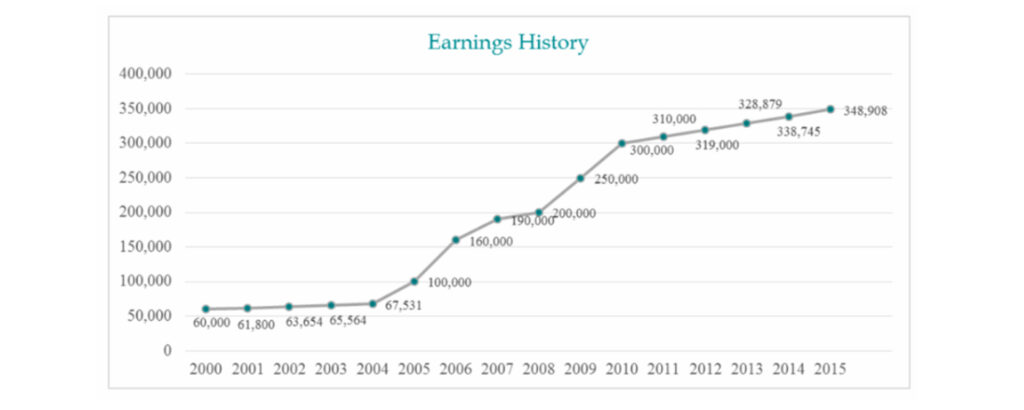
This graph is used for illustrative purposes only.
Their finances are identical between 2000 and 2004:
- Spending is $44,000 per year (increased annually by 3% inflation)
- They rent their homes
- Annual retirement contributions are 8% to a 401(k) and $2,000 to a Roth IRA
Things change in 2005 when their pay jumps. Joe:
- Buys a nice house in a solid middle-class neighborhood for $250,000 with 20% down and a 6% mortgage
- Starts spending $7,500 more now because he can afford it
- Total 2005 spending related to the home and lifestyle jumps to $66,000
- Increases Roth IRA contributions to $3,000
In 2006, Joe is tired of driving his 1-year-old Nissan Sentra with a broken stereo.
- Buys a fully loaded Toyota Camry for $28,000
- Increases Roth IRA contributions to $4,000
In 2007, the family takes a nice vacation costing $10,000, and Joe contributes $4,000 to his Roth IRA. In 2008, the purse strings loosen again and they increase their spending by $10,000.
Joe’s friend, Jim, starts spending more in 2005 as well. He doesn’t think Joe’s neighborhood is nice enough and finds a new development. He pays for crown molding even though he doesn’t know what it is, gets Viking appliances even though his wife hates cooking, and convinces himself he needs a bigger house than Joe even though their families are the same size.
Jim’s house is $400,000, his mortgage is $320,000, and his property taxes, maintenance, and expenses are higher than Joe’s.
Almost immediately he starts to keep up with the Joneses and adds $15,000 to his annual budget to buy Ethan Allen furniture, a whole house entertainment system, wine fridge, bigger grill, etc.
- In 2006, he goes car shopping with Joe, but cannot fathom the idea of a Camry and purchases a BMW 3 Series instead costing $45,000. He doesn’t contribute to his Roth that year, or any other account.
- In 2007, he puts a wine cellar in his basement costing $15,000. His family vacation that year costs $15,000.
- In 2008, he joins the country club. His total extra spending is $15,000.
- In 2009, Jim becomes the fourth person in his neighborhood to install a pool for $40,000.
After 2009 both families’ expenses increase by 3% per year. They save anything they didn’t spend in a portfolio invested in global stocks.
You’ve probably figured out that in this hypothetical example, differing spending and saving behaviors resulted in different outcomes, but how big do you think the difference was? Jot it down in percentage or dollar terms and see if you’re right.
Jim hypothetically accumulates approximately $1,209,000.
Joe hypothetically accumulates approximately $2,120,000 – a higher ending value in this example.
Families considering working with a financial advisor often reflect on how they built their savings. Most responses point to controlling spending and living below their means. One couple mentioned cutting each other’s hair, not as a literal strategy, but as a reflection of their mindset. No one points to spending freely as their income increased.
This is intended for informational purposes only. You should not assume that any discussion or information contained in this document serves as the receipt of, or as a substitute for, personalized investment advice from Savant. Please consult your investment professional regarding your unique situation.