
Potential Tax Benefits of Net Unrealized Appreciation

What is Net Unrealized Appreciation?
Net Unrealized Appreciation (“NUA”) is the difference between the cost basis of company stock held in the taxpayer’s 401(k) plan and the stock’s market value at the time it is distributed as part of a lump-sum distribution. To determine if the strategies explored in this article are appropriate for your specific situation, please consult with your financial advisor or CPA.
Normal Distributions from a 401(k)
The rules surrounding 401(k) plans stem from the Internal Revenue Code (IRC). The two most common types of 401(k) plans are traditional (also commonly known as “pre-tax” or “tax deferred”) and Roth (also commonly known as “after-tax”) plans. Traditional 401(k) plans will be the focus of this article.
Contributions made to a traditional 401(k) account help reduce the taxpayer’s income in the current year, and no tax is paid on the amount contributed to the 401(k). In addition, any appreciation of the investments held within a 401(k) account is not taxed. However, once an account holder withdraws from a traditional 401(k) account in subsequent years, the amount is taxed at ordinary income tax rates to the taxpayer.
Generally, withdrawals from 401(k) accounts made prior to age 59 ½ (barring a few exceptions) are subject to a 10% early withdrawal penalty.
Options for Traditional 401(k) Withdrawals
When a taxpayer retires or leaves a company while holding company stock in their traditional 401(k), they often must decide how to distribute those shares.
Taxpayers often make one of four choices (or a combination of choices) when withdrawing from their 401(k) plans:
- Take a withdrawal as a cash distribution,
- Roll both their company stock in-kind and remaining investment holdings into a traditional Individual Retirement Account (IRA),
- Roll both their company stock in-kind and remaining investment holdings into a subsequent employer-sponsored 401(k) plan, and/or
- Roll their company stock in-kind into a taxable investment account and roll the remaining investment holdings into a traditional IRA account.
Taking a withdrawal as a cash distribution requires the 401(k) plan administrator to sell the investment holdings within the plan and distribute the funds to the taxpayer in cash. As noted above, a cash distribution from a traditional 401(k) is taxed to the taxpayer at ordinary income rates, based on their taxable income in the year of the distribution. The amount which is taxed is the value of cash received. This is the fair market value of the investments at the time of sale, which includes both the original cost basis and any gains earned.
Rolling assets from a traditional 401(k) into either an employer-sponsored 401(k) or a traditional IRA doesn’t trigger a tax liability for the taxpayer. IRAs are tax-deferred and have similar tax benefits to those of 401(k) plans. Specifically, investments may grow tax-deferred within the IRA, and the taxpayer incurs tax only when taking a distribution.
Finally, some taxpayers may want to consider distributing any company stock in-kind to a taxable investment account and rolling the remaining assets into an IRA. The rollover of those remaining assets is treated as described above: the taxpayer incurs no tax.
However, moving company stock from a 401(k) account to a taxable investment account is treated differently. Because a taxable brokerage account is not tax-deferred, the taxpayer is treated as withdrawing the securities from the 401(k) and then depositing them into the investment account, and that withdrawal is subject to income tax. As discussed below, only the cost basis of the company stock (i.e., the original purchase price) is immediately taxed at ordinary income rates. The NUA on that stock is taxed differently.
Applying NUA to a 401(k) Withdrawal
Income tax liability is typically based on the fair market value of the withdrawal at ordinary income tax rates. However, if the company stock is distributed in-kind to a taxable brokerage account, the distribution is taxed only on the stock’s cost basis, not on the NUA (i.e., the growth in value since the shares were acquired). IRC Section 402(e)(4)(B) and IRS Notice 98-24 provide that in the case of a lump-sum distribution that includes employer securities, the net unrealized appreciation attributable to those securities is excluded from gross income.
When the company stock is sold, the NUA portion is taxed at long-term capital gains (LTCG) rates. Any subsequent appreciation of the company stock after distribution is taxed under normal capital gain rules based on the post-distribution holding period. Long-term capital gains are currently taxed at 0%, 15%, or 20% depending on the taxpayer’s taxable income level, whereas the highest ordinary income tax rate is currently 37%. Federal tax rates are subject to change and may differ based on individual circumstances. State and local taxes may also apply
NUA tax treatment may be advantageous in certain circumstances for taxpayers who have large amounts of highly appreciated company stock and can pay the additional tax liability from the cost basis of the company stock right away. This provides an opportunity for taxpayers to pay the lower LTCG tax rate in subsequent years when selling the company stock from their investment account.
How to Receive NUA Tax Treatment
To qualify for NUA tax treatment, taxpayers must meet all four of the following criteria:
- The entire vested balance of the 401(k) plan must be distributed within one tax year. However, the entire amount does not need to be distributed at once,
- Assets from all qualified plans held with the employer must be distributed, even if only one of the plans holds the company stock,
- The company stock must be distributed as actual shares. Conversion to cash prior to distribution is not allowed, and
- Taxpayers must experience one of the following:
- Separation from service from the company whose 401(k) plan holds the stock (except self-employed workers),
- Reached age 59 ½,
- Total disability (self-employed workers only), or
- Death.
NUA Example
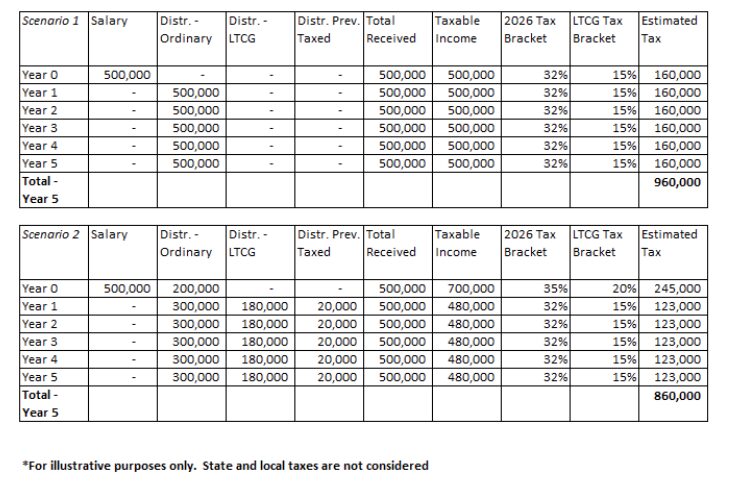
This example is hypothetical and provided solely for educational purposes. Results will vary based on a taxpayer’s individual circumstances, including tax bracket, stock concentration, holding periods, future tax law changes, and the relative cost basis of employer stock. NUA treatment may not result in lower taxes in all situations.
Married Filing Jointly Taxpayer Retires in Year 0
Salary in Year 0 = $500K
Projected Distributions after retirement = $500K per year over 10 years (first five years illustrated in chart below)
Total traditional 401(k) assets valued at $5M
Includes company stock with value of $2M and basis of $200K
Scenario 1
All traditional 401(k) assets rolled into traditional IRA in Year 0
Distributions begin Year 1
Scenario 2
Non-company stock assets rolled into traditional IRA in Year 0
Company stock rolled into investment account in Year 0
Distributions begin Year 1 – pro-rata between non-company stock assets and company stock. The company stock is assumed to be liquidated evenly over 10 years, generating $180,000 of NUA LTCG annually.
Simplified Tax Illustration
The example below is a simplified hypothetical illustration based on the stated assumptions and should not be interpreted as representative of any actual investor’s experience.
Employer stock positions may involve concentration risk, and tax considerations should be evaluated alongside investment-risk considerations. This is intended for informational purposes only. You should not assume that any discussion or information contained in this document serves as the receipt of, or as a substitute for, personalized investment or tax advice from Savant. Please consult your investment or tax professional regarding your unique situation.