
Navigating Retirement Account Distribution Strategies

Retirement planning is a journey, and as with any journey, it is crucial to map out your route. When it comes to retirement accounts like 401(k)s and IRAs, one key aspect of this progression is understanding distribution strategies. How you withdraw money from these accounts can impact your financial future.
Distribution Strategies Prior to Age 59 ½
Before you reach the age of 59 ½, withdrawing funds from your 401(k) or IRA may be costly. Usually, early withdrawals come with a hefty penalty of 10% on top of the regular income tax. This can diminish the value of the money you have worked so hard to save. However, there are a few strategies that may help certain individuals access retirement assets more efficiently and, depending on their circumstances, may affect their tax liability.
- The Rule of 55
One valuable option to those leaving their job at age 55 or later is the Rule of 55. This rule applies only to 401(k) plans, not IRAs. Under the Rule of 55, if you leave your job at age 55 or older, you may withdraw funds from your 401(k) without incurring the 10% early withdrawal penalty. This provides a window of flexibility for early retirees who want to access their retirement savings. There are several things to keep in mind to avoid running afoul of the IRS:
You must have left your job in the calendar year in which you turn 55 to be eligible for the penalty-free distributions.
Withdrawals can only be made from the retirement plan sponsored by the employer you are leaving, not from your IRAs or retirement plans with previous employers. Withdrawals from other accounts will still incur penalties.
The account balance must remain in the 401(k) plan to continue receiving penalty-free withdrawals. Once you reach age 59 ½, and are no longer subject to early withdrawal penalties, you can roll the account balance into an IRA.
- Roth IRA Withdrawals
Another strategy for making retirement account withdrawals prior to age 59 ½ is tapping into your Roth IRA contributions. Unlike traditional IRAs and 401(k)s, Roth IRAs allow you to withdraw your contributions at any time, tax- and penalty-free. Keep in mind that this rule applies only to your contributions, not the earnings on those contributions.
If early retirement is your goal, it may be worth considering a Roth IRA conversion ladder to plan penalty-free retirement account withdrawals prior to age 59 ½. Discuss this strategy with your financial advisor to align the ladder with your overall financial strategy and help it comply with IRS regulations and guidelines.
- The Substantially Equal Periodic Payments (SEPP) Rule
The IRS provides a way to potentially avoid early withdrawal penalties with the Substantially Equal Periodic Payments (SEPP) rule. Under SEPP, you can take substantially equal payments from your retirement account without incurring the early withdrawal penalty. These payments must follow an IRS-approved calculation method and continue for at least five years or until you reach age 59 ½, whichever is longer.
The three methods are (1) the amortization method, (2) the life expectancy method, and (3) the annuitization method.
Amortization Method: This method determines the allowable withdrawal amount by amortizing the retirement account balance over the account holder’s single or joint life expectancy. It may result in the largest amount an individual can withdraw, and that amount will be fixed for the duration of the SEPP.
Life Expectancy Method: This method is sometimes referred to as the “minimum distribution” method and, as you might guess, generally results in the smallest possible withdrawal amount. It takes the life expectancy factor from either the single or joint life expectancy tables provided by the IRS to divide the retirement account’s balance. Due to the way it is calculated, the withdrawal amount is adjusted annually as the account balance changes.
Annuitization Method: This method uses an IRS-provided annuity factor to determine the annual payment that may be withdrawn penalty-free from the retirement account. The resulting payment generally falls between the amounts produced by the amortization and life expectancy methods. As with the amortization method, the withdrawal amount stays the same each year.
If a taxpayer is taking withdrawals under the SEPP exception, modifying or prematurely ending the payments may trigger penalties. However, the IRS allows a one-time change from the amortization or annuitization method into the life expectancy method without penalty. Taxpayers typically make this switch after a significant decline in the account value, which lowers the required distribution and allows the remaining balance to last longer. This strategy is available in Individual Retirement Accounts (IRAs) and employer-sponsored plans such as a 401(k) or 403(b).
Bankrate has a simple calculator if you would like to see how much you may be able to withdraw from your retirement accounts using SEPP.
Substantially Equal Periodic Payments are likely the most complex way to access your retirement accounts before age 59½. In many cases, the other two strategies discussed above are much simpler to implement. Consult your financial advisor to determine which option may be most appropriate for your circumstances.
Distribution Considerations After Age 59 ½
- No Penalty for Early Withdrawals
Once you reach age 59½, the 10% early withdrawal penalty no longer applies. You can access your retirement accounts without that additional tax, which makes this a good time to consider more flexible withdrawal strategies.
- Consider Your Tax Bracket
Evaluate your current and expected future tax brackets before deciding how much to withdraw. By strategically managing withdrawals in retirement, some retirees may be able to improve the tax efficiency of their withdrawal strategy. This might include taking advantage of lower tax brackets in early retirement or spreading out withdrawals to potentially avoid moving into higher tax brackets later on.
- Required Minimum Distributions (RMDs)
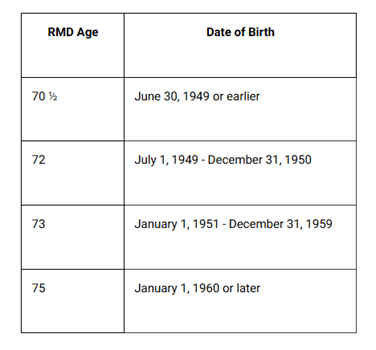
You must begin taking required minimum distributions (RMDs) from IRAs and employer-sponsored plans such as 401(k)s and 403(b)s once you reach a certain age (see table below). These distributions are subject to income tax, and failure to take them may result in substantial penalties.
- Diversify Your Tax Liability
Consider diversifying your retirement savings to manage future tax liabilities. Balancing traditional pre-tax accounts (like 401(k)s and traditional IRAs) with post-tax accounts (like Roth IRAs or brokerage accounts) may provide tax flexibility in retirement. You can choose which accounts to draw from based on your tax situation.
- Seek Professional Guidance
Determining how to create income in retirement can be complex, with potential tax implications. Be sure to consult a qualified financial advisor or tax professional who can tailor a distribution strategy to your unique circumstances.
Whether you are considering withdrawals before or after age 59 ½, or looking to optimize your overall retirement plan, careful planning and consultation with qualified professionals can help individuals evaluate retirement distribution options and related tax considerations.
This is intended for informational purposes only. You should not assume that any discussion or information contained in this document serves as the receipt of, or as a substitute for, personalized investment or tax advice from Savant. Please consult your investment or tax professional regarding your unique situation.