
Rebalancing: The Simple Habit That Keeps Your Investment Blueprint on Track
Markets are always reshaping your portfolio. Rebalancing can help put it back in line with your plan, and it may help you manage risk, buy low and sell high, and stay steady when markets get rough.
In a recent article, we compared a well-built investment plan to an architectural blueprint: carefully designed, built on a solid foundation, and meant to last. One of the tools we mentioned for keeping that structure sound was rebalancing. It is one of the simplest habits in investing, and one of the most valuable.
Think of it like routine home maintenance. Even a well-built house settles over time. Doors start to stick, and floors drift slightly out of level. Nothing is broken, but small shifts add up. Your portfolio works the same way. As markets rise and fall, your mix of investments slowly moves away from the plan you chose. Rebalancing is the regular checkup that brings it back.
Rebalancing at a Glance
What it is: Periodically adjusting your investments back to your target mix, such as 60% stocks and 40% bonds.
Why it matters: It can help keep your risk at the level you chose, and research suggests it may mean a smoother ride and smaller losses when markets fall.
When to act: For most investors, rebalancing when your mix drifts about 5 percentage points from target is a good way to stay on track.
What Rebalancing Looks Like in Practice
Say you have a $1 million portfolio with 60% in stocks and 40% in bonds, what many investors call a “60/40” mix. Stocks tend to offer more growth over time but bounce around more. Bonds tend to be steadier. Together, the mix aims to balance growth with stability.
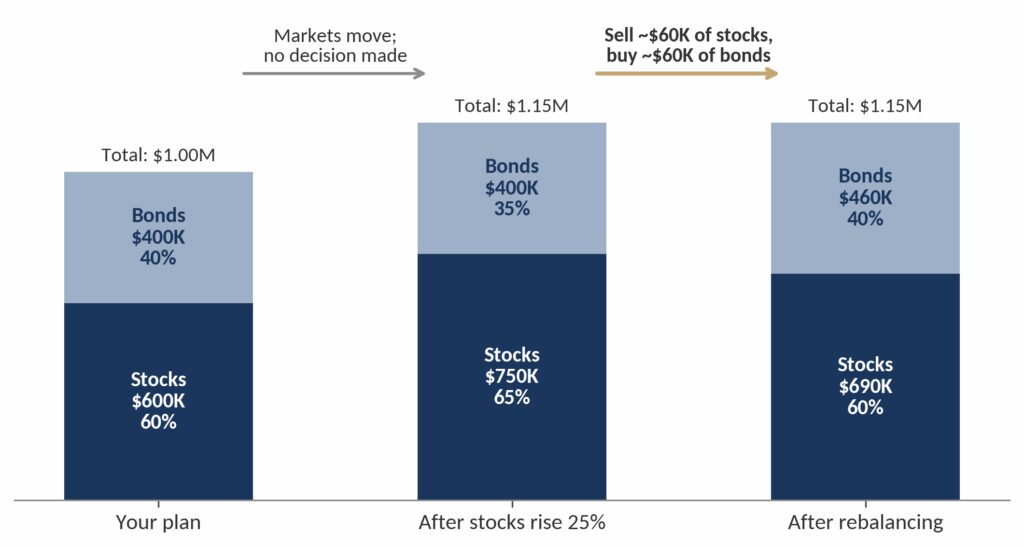
Now imagine stocks have a great year and rise 25% while bonds stay flat. Your stocks are now worth $750,000 and your bonds $400,000. Your portfolio has grown to $1.15 million, which is good news. But stocks now make up 65% of it instead of 60%, so you are taking more risk than you signed up for without ever deciding to.
Rebalancing fixes that. You would sell about $60,000 of stocks and use the proceeds to buy bonds, bringing the mix back to 60/40 (Exhibit 1). In effect, you lock in some of the gains from what did well and add to what is now relatively less expensive.
EXHIBIT 1
REBALANCING IN ONE PICTURE
A simplified example of a $1 million portfolio with a 60% stock/40% bond target
Why Your Mix Drifts, and How Far It Can Go
Over long periods, stocks have tended to grow faster than bonds. So a portfolio you leave alone tends to drift toward a higher percentage in stocks, especially after good years.
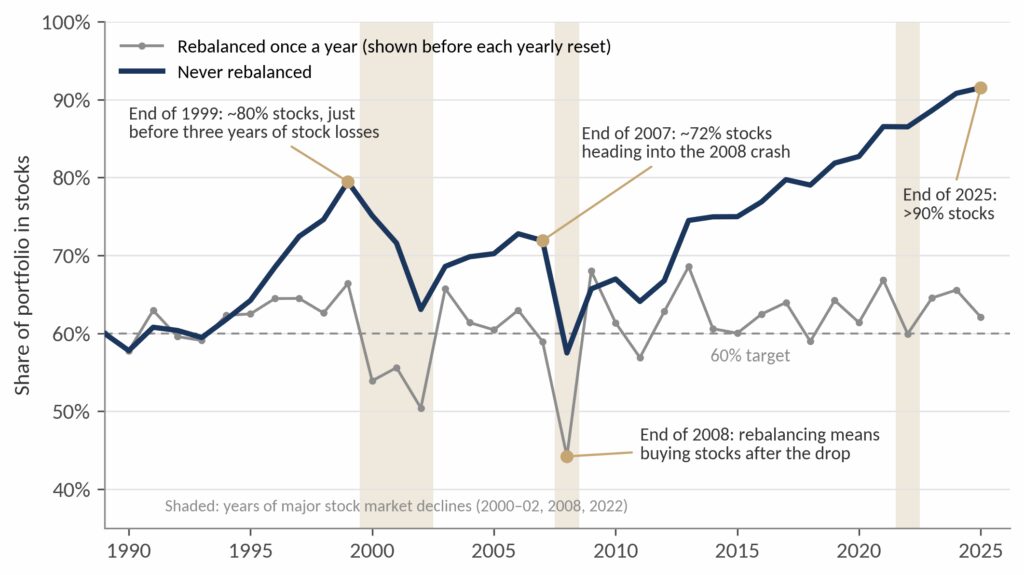
That drift can happen quickly. If you had started a 60/40 portfolio at the beginning of 2023 and never rebalanced it, it would have ended 2025 at about 72% stocks, based on historical returns for U.S. stocks and 10-year Treasury bonds. Over longer stretches, it goes much further. Start the same hands-off portfolio in 1990, and it would have reached about 80% stocks by the end of 1999, right before three straight years of stock losses, and more than 90% stocks by the end of 2025 (Exhibit 2). Vanguard found a similar pattern in a globally diversified portfolio.
Why does that matter? A portfolio that is 90% stocks can behave very differently from one that is 60% stocks when markets fall. At that point, the risk you are carrying is no longer the risk you built your plan around.
EXHIBIT 2
HOW A 60/40 PORTFOLIO QUIETLY BECOMES SOMETHING ELSE
Share of a hypothetical 60% stock/40% bond portfolio held in stocks, starting January 1, 19901
The Benefits of Rebalancing
Rebalancing isn’t flashy, but decades of research and market history point to the potential for real advantages.
A smoother ride. Morningstar compared 60/40 portfolios that rebalanced on different schedules with one that never rebalanced. The rebalancing approaches illustrated reduced the portfolio’s ups and downs, a measure investors call volatility, by roughly 15%. An AAII study using portfolios of widely available index funds found that rebalancing once a year cut volatility by about 10% over 25 years.
Smaller losses when markets fall. When stocks dropped sharply at the start of the COVID-19 pandemic in early 2020, the never-rebalanced portfolio in Morningstar’s study lost 27.8%, compared with about 21% for portfolios that rebalanced quarterly or yearly. In the AAII study, rebalancing made 2008 losses about 18% to 19% smaller. Our own analysis tells a similar story: In 2008, a 60/40 portfolio that rebalanced every year lost about 14%, compared with nearly 21% that sat untouched since 19901.
Buy low and sell high, automatically. Rebalancing builds in the discipline most investors find hardest. After strong markets, it trims what has grown. After declines, it adds to what has fallen. At the end of 2008, for example, a 60/40 portfolio that rebalanced at the end of 2007 would have slipped to about 44% stocks. Rebalancing meant buying stocks at much lower prices, just ahead of 2009, when U.S. stocks returned about 26%.
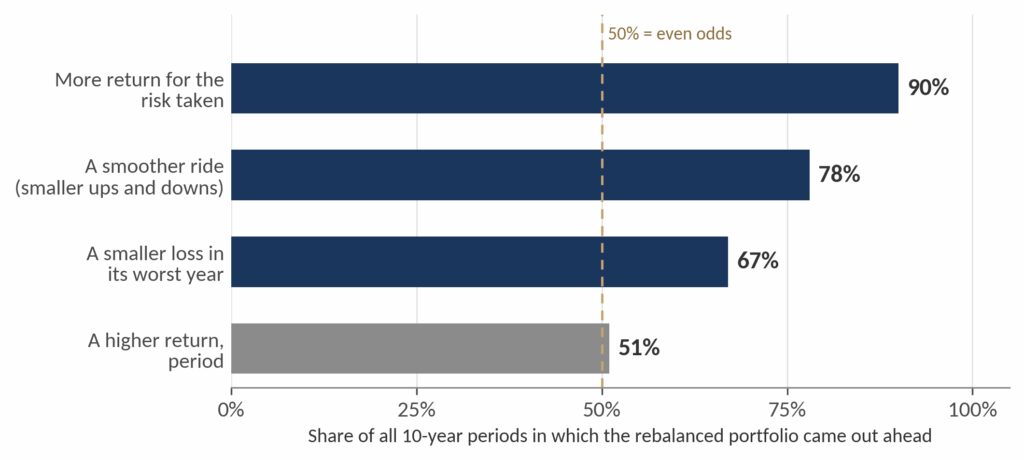
Potential for More return for the risk you take. Rebalancing’s main job is managing risk, but that doesn’t necessarily mean giving up much return. We looked at every 10-year period from 1928 through 2025. A portfolio that rebalanced once a year earned more return for the risk it took in about nine out of 10 of those periods, and it earned a higher return outright about half the time (Exhibit 3). Morningstar likewise found that rebalanced portfolios could potentially provide better returns for the risk they took than a buy-and-hold portfolio over every period it measured, from one year to 15 years. And in AAII’s 25-year study, rebalancing slightly improved returns while lowering volatility.
Clarity and a plan to follow. Perhaps the biggest benefit is behavioral. Rebalancing can help give you a clear, preset action when markets are unsettling, instead of a decision you make in the heat of the moment. Smaller losses can also make it easier to stay invested. As AAII noted, the difference may keep an investor from panicking and selling near the bottom.
Your plan stays your plan. Your retirement income projections, spending strategy, and comfort level all rest on a specific mix. Rebalancing can help keep that mix, and everything that depends on it, intact.
EXHIBIT 3
HOW OFTEN REBALANCING CAME OUT AHEAD
Rebalanced yearly vs. never rebalanced: a hypothetical 60/40 portfolio across all 89 rolling 10-year periods, 1928–2025
Design insight: Can a portfolio you leave alone sometimes earn more? Yes, usually during long rising markets, because it has quietly become a riskier portfolio. From 1990 through 2025, for example, the hands-off 60/40 earned roughly half a percentage point more per year, but it ended the period more than 90% in stocks and lost far more in 2008.1 Rebalancing is how you pursue the returns your plan targets, with the level of risk you actually chose.
Savant’s Approach to Rebalancing
At Savant, we believe in the importance of both rebalancing and tax-efficient investing, so we take steps to balance those objectives:
- Rebalance based on risk tolerance. Monitor portfolios for drift from their intended risk profile, so each trade meaningfully moves them back on target.
- Use new money first. Direct contributions and dividends toward what is underweight, and take withdrawals from what is overweight, before selling anything.
- Use retirement accounts. Rebalance inside retirement accounts when possible, where trades don’t trigger taxes.
- Stay flexible in taxable accounts. Allow some room in taxable accounts instead of chasing an exact target.
- Sell thoughtfully. Offset gains with losses where available, and favor selling investments you have held longer than a year since the IRS generally taxes those gains at lower rates.
It can also help to be deliberate about which investments you hold in which accounts, what planners call asset location. Vanguard’s research suggests this can potentially add meaningful value after taxes, depending on your tax bracket and mix of accounts. That is one reason investment and tax planning work best together. Taxes should shape how you rebalance, but they shouldn’t leave your portfolio drifting far from your plan.
If It Feels Uncomfortable, It’s Probably Working
Rebalancing can feel backward in the moment. After a great run, it asks you to trim your winners. After a downturn, it asks you to buy what just fell. That discomfort is normal, and it is a sign the habit is doing its job: steering you away from the common mistake of buying high and selling low.
Markets will keep reshaping your portfolio whether you check on it or not. Rebalancing is the simple habit that can help keep what you own matched to what you planned. It’s designed to help manage risk, aims to soften the blow of downturns, and helps put discipline to work when emotions run high.
Important Disclosures
This is intended for informational purposes only. You should not assume that any discussion or information contained in this document serves as the receipt of, or as a substitute for, personalized investment or tax advice from Savant. Please consult your investment or tax professional regarding your unique situation.
The portfolio examples and historical analyses shown are hypothetical and for illustrative purposes only. They do not reflect the results of actual trading or the experience of any Savant client. Results were calculated using annual total returns for the S&P 500 Index and 10-year U.S. Treasury bonds, assuming the rebalancing conventions stated with each exhibit, and excluding contributions, withdrawals, advisory fees, transaction costs, and taxes. Actual results may differ materially. Indexes are unmanaged and cannot be invested in directly. Past performance is not indicative of future results. Rebalancing does not assure a profit or protect against loss in declining markets.
 Kevin G. Bond
Investment Research Analyst
Kevin G. Bond
Investment Research Analyst