
Sustainable Investing: Aligning Investments with Your Personal Values

Sustainable investing has evolved significantly over the past decade. Investors once treated it as a niche approach, but it now comes up regularly in conversations with their advisors.
While definitions vary, sustainable investing incorporates environmental, social, and governance (ESG) considerations into the investment process alongside traditional financial analysis. These considerations include climate and environmental impacts, labor practices, corporate governance, business ethics, and community engagement. At its core, sustainable investing aims to align a portfolio with an investor’s personal values without losing sight of long-term financial objectives.
Sustainable investing also isn’t a single, standardized approach. It exists on a spectrum because different investors prioritize different issues. As a result, two sustainable strategies can pursue similar objectives yet hold meaningfully different portfolios.
How Sustainable Strategies Work
Many investors associate sustainable investing with excluding certain industries or companies from a portfolio. Exclusions are one tool, but many strategies take a broader approach. A common method is an ESG “tilt,” where managers increase exposure to companies with stronger ESG characteristics and reduce exposure to those with weaker ones. This approach folds in sustainability considerations while maintaining broad diversification.
To evaluate companies, fund managers often rely on third-party research providers that assess factors such as carbon emissions, resource usage, corporate governance, employee relations, product safety, and community impact.
Performance Considerations
Investors often ask whether incorporating ESG factors sacrifices performance. We believe a well-constructed portfolio should remain grounded in principles such as diversification, cost efficiency, disciplined risk management, and broad exposure across markets and asset classes. At Savant, we build portfolios that incorporate ESG considerations with those principles in mind.
To create a meaningful comparison, we contrasted the MSCI USA NR Index with the MSCI USA ESG Select NR Index. Both indices start with the same universe of stocks (U.S. large- and U.S. mid-cap), but the ESG Select Index targets companies with stronger environmental, social, and governance characteristics. That comparison helps isolate any performance impact that comes from favoring those companies.
Figure 1: Performance and Risk Comparison
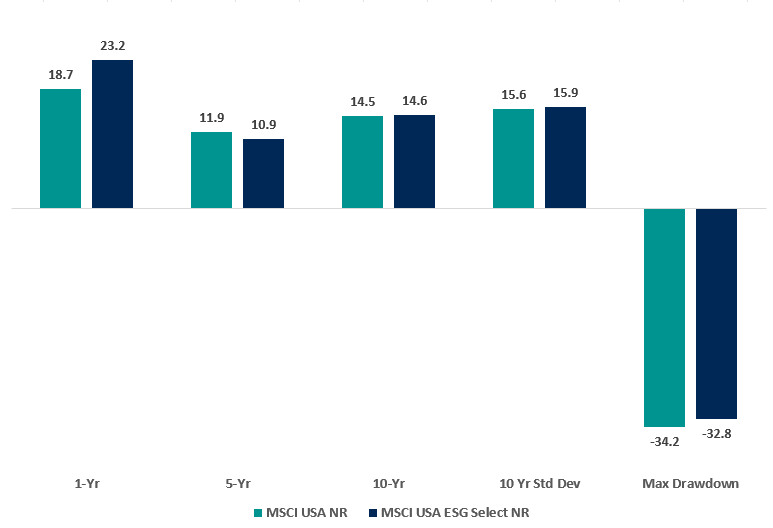
Figure 1 shows that the ESG-screened stocks generated risk and return similar to the broad U.S. stock index. The ESG index may slightly outperform or marginally underperform an unscreened index in a given stretch, but historically it has tracked the broad index closely.
Still, investors should weigh the trade-offs. Sustainable strategies generally invest within a more constrained opportunity set than traditional strategies and may underperform broader market benchmarks during certain market environments. As with any investment decision, these portfolio differences can help or hinder results depending on prevailing market conditions.
Sustainable investing is less about identifying short-term winners and losers and more about seeking to build a portfolio that reflects an investor’s financial objectives and preferences. We believe investors who prioritize these considerations can remain invested in a diversified, evidence-based portfolio while directing capital toward businesses with stronger ESG characteristics.
Savant’s Approach
At Savant, we view sustainable investing as one of many ways investors can tailor a portfolio to reflect their preferences and priorities. ESG considerations may shape portfolio construction, but the same principles that guide traditional portfolio design still apply, including diversification, cost efficiency, risk management, and long-term discipline.
Our evaluation process focuses on how managers incorporate ESG considerations, the trade-offs their approach creates, and the impact those decisions may have on overall portfolio exposures. Investor priorities can differ significantly, so these conversations work best within the context of a broader financial plan and long-term objectives.
Our role is not to prescribe a universal definition of sustainable investing. Instead, we can help investors understand the available approaches, weigh the trade-offs, and decide whether a strategy aligns with their goals and preferences.
Please Note: Socially Responsible Investing Limitations. Socially Responsible Investing involves the incorporation of Environmental, Social, and Governance considerations into the investment due diligence process (“ESG”). There are potential limitations associated with allocating a portion of an investment portfolio in ESG securities (i.e., securities that have a mandate to avoid, when possible, investments in such products as alcohol, tobacco, firearms, oil drilling, gambling, etc.). The number of these securities may be limited when compared to those that do not maintain such a mandate. ESG securities could underperform broad market indices. Investors must accept these limitations, including potential for underperformance. Correspondingly, the number of ESG mutual funds and exchange-traded funds is fewer than those that do not maintain such a mandate. As with any type of investment (including any investment and/or investment strategies recommended and/or undertaken by Savant), there can be no assurance that investment in ESG securities or funds will be profitable, or prove successful.
This is intended for informational purposes only. You should not assume that any discussion or information contained in this document serves as the receipt of, or as a substitute for, personalized investment advice from Savant. Please consult your investment professional regarding your unique situation. Historical performance results for investment indices, benchmarks, and/or categories have been provided for general informational/comparison purposes only, and generally do not reflect the deduction of transaction and/or custodial charges, the deduction of an investment management fee, nor the impact of taxes, the incurrence of which would have the effect of decreasing historical performance results. It should not be assumed that your account holdings correspond directly to any comparative indices or categories. Please also note: (1) performance results do not reflect the impact of taxes; (2) comparative benchmarks/indices may be more or less volatile than your accounts; and (3) a description of each comparative benchmark/index is available upon request.
 Torin E. Kasper
Investment Strategist
MS
Torin E. Kasper
Investment Strategist
MS