
Roth 401(k) or Regular 401(k)? Here’s How to Decide
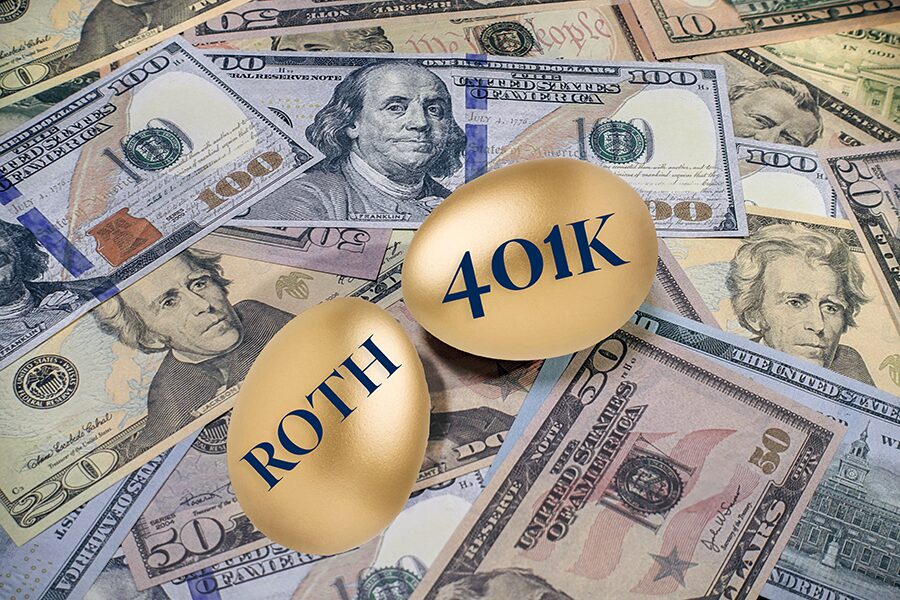
Many employers now offer a Roth 401(k) option in their 401(k) retirement plans for employees. With this option, you can make contributions to a Roth 401(k) or regular 401(k), or both, all within the same 401(k) account. The different types of contributions are kept separate within the account.
If your employer offers this option, you may be wondering whether and how much to contribute to the Roth 401(k) versus regular 401(k) option. Generally, the answer depends on your current and future income tax rates.
With a Roth 401(k), your contributions are after-tax, meaning they do not reduce your taxable income. You make contributions with income for which you have already been taxed. In contrast, regular 401(k) contributions are made pre-tax, meaning they reduce your taxable income, and the amount you contribute is subtracted from your income for tax purposes. A regular 401(k) reduces your taxable income as you contribute while a Roth 401(k) does not.
With both a Roth 401(k) and regular 401(k), you are not taxed on earnings as investments in your account grow in value, allowing your investments to grow faster than they otherwise would in a taxable brokerage account. This is a key advantage of saving in a 401(k) plan.
Once you retire and begin withdrawing funds, a Roth 401(k) and regular 401(k) again have different income tax treatment. Qualified withdrawals from a Roth 401(k) are generally not taxed, but withdrawals from a regular 401(k) are taxed at your ordinary income tax rate.
The key question, then: When is the best time to pay taxes?
Should you pay tax while you’re contributing, as would be the case with a Roth 401(k)? Or is it better to pay tax later while withdrawing funds, as would be the case with a regular 401(k)? Unfortunately, there isn’t a single correct answer that applies to everyone. The best option strongly depends on your income rate now compared to your income tax rate in retirement.
A commonly cited rule of thumb is that if your income tax rate is higher now than it will be in retirement, some individuals may find directing more or all of their contributions to a regular 401(k). If your income tax rate is lower now than it will be in retirement, some individuals may find it beneficial to direct more or all of their contributions to a Roth 401(k). In individual situations, the answer can be less straightforward because other factors are involved as well. It’s often the case that your income tax rate now must exceed your income tax rate in retirement by a certain amount for a regular 401(k) to outperform a Roth 401(k).
You can use an online calculator like the one offered by Bankrate to look at your specific situation. As an example of how to use the calculator, assume these inputs, which vary the retirement tax rate:
- Current age: 40
- Age of retirement: 60
- Annual contribution: $24,500 (for 2026)
- Invest traditional tax-savings: Check
- Maximize contributions: Check
- Expected rate of return: 7%
- Current tax rate: 25%
- Retirement tax rate: 15%, 20%, 21% and 25%
This example is hypothetical and for illustrative purposes only. It does not represent actual investment results or individualized tax or investment advice.
Notice that for retirement tax rates of 15% and 20%, this hypothetical analysis shows regular 401(k) contributions producing a higher projected after-tax balance than Roth 401(k) contributions; by contrast, with a retirement tax rate of 25%, a Roth 401(k) produces a higher projected result under these assumptions. The breakeven point is at about 21% retirement tax rate in this example.
What’s really important here is the difference between the current tax rate and retirement tax rate. In this example, once the difference between the tax rates is greater than 4%, it starts making sense to contribute to a Roth 401(k). For high-income earners whose tax rates are higher now than they will be in retirement, regular 401(k) contributions often provide the most amount of money available to withdraw in retirement. Use the calculator to see what makes sense in your situation.
To learn more about 401(k) retirement plans, see What High Earners Need to Know About Roth Catch-Up Contributions in 2026 and Should You Consolidate Your Retirement Accounts?
This is intended for informational purposes only. You should not assume that any discussion or information contained in this document serves as the receipt of, or as a substitute for, personalized investment or tax advice from Savant. Please consult your investment or tax professional regarding your unique situation.
 Bruce R. Barton
Managing Partner / Financial Advisor
CFP®, CFA®, MBA
Bruce R. Barton
Managing Partner / Financial Advisor
CFP®, CFA®, MBA