
Seeing Isn’t Believing: What Recent Outages and AI Deepfakes Mean for You

Over the past few months, you may have experienced, or heard about others experiencing, unexpected disruptions to email or online banking. The last week alone brought two big ones. On Nov. 12, a Microsoft outage knocked out Outlook, Teams, and other services for users around the world.¹ Four days later, customers at Chase, Bank of America, Wells Fargo, and other major banks had trouble logging in, checking balances, and moving money.²
Microsoft said its outage wasn’t a cyberattack, and Chase pointed to a software problem. Still, back-to-back disruptions like these understandably leave people wondering whether their accounts and personal information are safe, or even under attack. More than anything, that kind of uncertainty can erode trust in the institutions we rely on every day.
The good news is that, for the most part, these outages aren’t necessarily a sign of an attack or that technology is getting worse. Software is changing faster than ever, and some breakage comes with that. In some cases, outages may occur as companies make software and security updates, and a few simple habits can go a long way toward helping protect you.
More Fixes Mean More Change
Artificial intelligence has made finding flaws in software much faster and cheaper. Security teams are finding more holes to fix, and criminals are finding more holes to exploit. As of mid-November 2026, more than 100,000 software flaws have come to light this year, more than double the total for all of 2025.³
That leaves companies little choice but to patch more often and more quickly. Today’s software is also a bit like a layer cake. The app on your phone sits on cloud services, networks, and code from dozens of other companies, and all of those layers are updating at once. When everything is moving, a change in one layer can occasionally knock something over in another. Staffing reductions at some tech companies may also affect the resources available for testing and oversight.
In my view, a few hours of downtime is a reasonable price for closing security gaps faster. It’s a lot cheaper than a data breach.
The Bigger Risk: A Face or Voice You Trust
Software flaws grab the headlines, but for most people the bigger vulnerability is much closer to home: someone pretending to be a person you trust. Rather than breaking through technical defenses, criminals increasingly just ask for the keys.
Mandiant, Google’s cybersecurity research unit, found that phone-based scams were the second most common way attackers got in last year, at 11% of intrusions, while email phishing fell to just 6%.⁴
The same AI progress is making it remarkably easy to impersonate a real person, and I don’t think most people realize how far it has come. Cloning someone’s voice now takes as little as three seconds of audio, the kind of clip that sits in a social media video or a voicemail greeting.⁵ Video has caught up, too. Legitimate companies such as Tavus now sell “AI replicas” that can hold a live, two-way video conversation in real time. A replica of a real person takes about two minutes of video to build, and plans that include one start at about $59 a month.⁶ Tavus requires the person being cloned to record a consent statement.⁷ Free, open-source tools don’t ask, and they need even less. One popular program swaps a person’s face onto a live webcam feed using a single photo, and it runs on an ordinary laptop.⁸
What It Takes to Fake Someone Today
| To fake… | What a scammer needs | Rough cost |
|---|---|---|
| Their voice on a phone call | About 3 seconds of audio | Low-cost apps |
| Their face on a live video call | One photo | Free |
| A talking video clone that holds a conversation | About 2 minutes of video | About $59 a month |
In one widely reported case, an employee at the engineering firm Arup wired $25.6 million after a video call with what looked like the company’s chief financial officer and several colleagues, all of whom turned out to be deepfakes.⁹ The FBI has since warned that scammers are using real-time video to pose as executives, law enforcement, and other authority figures.¹⁰
For years, the standard advice was to ask for a video call if something felt off, but that advice doesn’t hold up the way it used to. This technology makes two kinds of scams much harder to spot, especially for older or more vulnerable family members. The first is impersonation: a call or video chat that looks and sounds like a grandchild, a business partner, or a trusted professional asking for money right away. The second is what’s often called “pig butchering,” a long con where a scammer builds trust over weeks or months, then steers the victim into a fake investment. A convincing face on a video call removes one of the last checks people relied on.
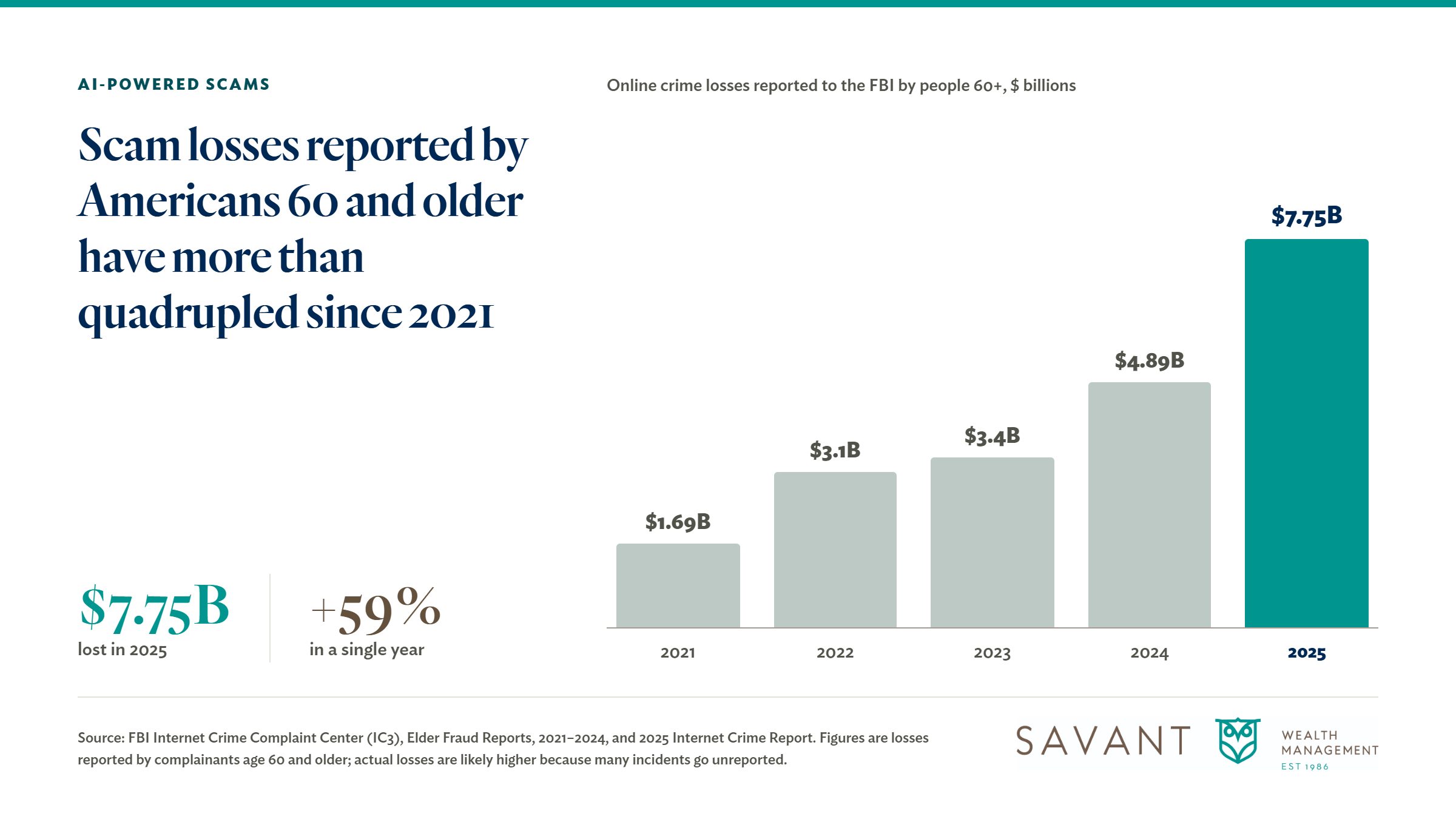
The losses are already significant. Americans reported nearly $21 billion in online crime losses to the FBI in 2025, and people 60 and older lost $7.75 billion of that, up 59% from the year before.¹¹ Investment scams were the costliest category.
Focus on What You Can Control
As with investing, you can’t control the headlines, but you can control your own habits. These steps can help:
Protect Your Family
- Set a family code word: Agree on a word only your family knows, and ask for it whenever someone calls or video chats asking for money, no matter how real they look or sound.
- Call back before you move money: If anyone asks you to send money or change account details, hang up and call back on a number you already know. That includes calls that seem to come from us.
- Don’t treat a video call as proof: A live face on screen can now be faked with a single photo. If a video call ends in a request for money, verify it another way first.
- Treat urgency as a red flag: Pressure to act right now is a classic scam tactic, and AI makes the pitch more convincing.
- Name a trusted contact: Most account custodians let you name someone we can reach if something ever seems off. Your Savant financial advisor can help you set one up.
Protect Your Accounts
- Use an authenticator app or passkey: These are much harder to intercept than text-message codes.
- Never share a login code: Not with anyone who calls, texts, or emails you, even if they sound like your bank or tech support.
- Use a password manager: A unique password for every account limits the damage if someone steals one.
- Turn on alerts: Set up notifications for logins and money movement on your financial accounts.
- Keep devices updated: Updates occasionally break things, but they’re how companies close security holes.
Expect Hiccups, Stay Prepared
An outage does not necessarily mean a company has suffered a cyberattack or that the broader system is failing. The bigger risk is a scam that looks and sounds like someone you trust. At Savant, we approach security the same way we approach investing: We don’t predict. We prepare.
This is also a good time for a quick conversation with parents, grandparents, and adult children about a family code word. It takes five minutes and can add another layer of verification if an unexpected request comes in.
If anything about a request involving your accounts ever feels off, reach out to your Savant financial advisor directly. We’re always here to help.
This is intended for informational purposes only. You should not assume that any discussion or information contained in this document serves as the receipt of, or as a substitute for, personalized investment advice from Savant. Please consult your investment professional regarding your unique situation.
Sources
- Microsoft hit by global outages: What happened and why? (Al Jazeera)
- Customers at major US banks report difficulty with some online services (Associated Press)
- This year’s bug count just passed 100K (The Register)
- M-Trends 2026: Data, Insights, and Strategies From the Frontlines (Mandiant, Google Cloud)
- AI voice cloning scams and the family safe word (Fortune, citing McAfee research)
- Tavus pricing (Tavus)
- Personal Replicas: training from about 2 minutes of video, consent required (Tavus documentation)
- Deep-Live-Cam: real-time face swap from a single image (GitHub)
- A deepfake ‘CFO’ tricked Arup in $25 million scam (Fortune)
- FBI Public Service Announcement I-072026-PSA (FBI IC3)
- 2025 Internet Crime Report (FBI Internet Crime Complaint Center)
 Chip Kalousek
Director of Investment Research and Innovation
CFA®