
Markets: Politically Agnostic, Not Immune to Uncertainty
What It Means for You
- Washington is divided. After the 2026 midterms, the different parties control the White House and Congress, which tends to limit how much policy can change, and how fast.
- Markets welcomed the clarity. Stocks rallied as election uncertainty lifted, a pattern that has generally held regardless of which party wins.
- The lame-duck window is the next test. A budget standoff before the new Congress is seated could bring short-term volatility, which our planning and diversification are designed to help you weather.
What Happened
Democrats won control of both the House and the Senate in the November 3, 2026, midterms, while the White House remained under Republican leadership.¹
Investors responded quickly. On November 4, the day after the election, the Dow Jones Industrial Average rose 3.0% to 53,356, and the S&P 500 and small-cap Russell 2000 each gained 1.6%.² Falling oil prices helped too, and one day is not a trend. But the direction fits a familiar pattern.
Why Markets Rallied
Which party controls Washington has shown little to no power to predict future market returns. Yet election seasons reliably bring uncertainty, and investors demand higher expected returns as compensation for bearing it. When an outcome removes some political uncertainty, markets may respond favorably.
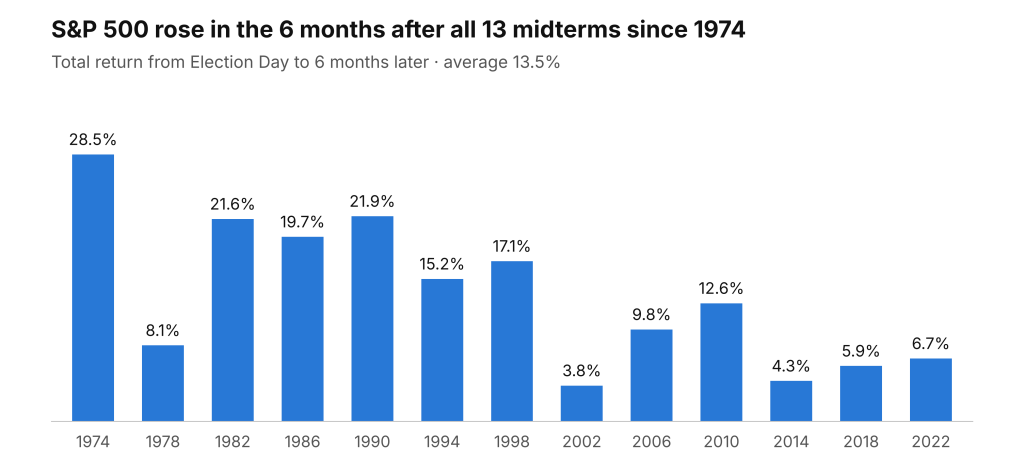
The pattern held through recessions, rate shocks, and every mix of party control. It is not a forecast, but it is a reminder that election outcomes are rarely what drives long-term returns.³
Power Is Still Divided
Divided government acts as a brake on policy. The Constitution splits power across three branches, and after the 2026 midterms, no single party holds both the White House and Congress.
Change will come, but its scope is narrower than under single-party control. That gives markets more certainty, not less. Since 1874, the 12 months after midterms that produced divided government under a Republican president averaged an 18% return, positive in 13 of 14 cases.³
Looking Ahead: The Lame-Duck Window
The current Congress keeps voting control until new members take office on January 3, 2027. The key date in that window is December 11, 2026, when the stopgap government funding bill expires.⁴
Outgoing lawmakers may use their final weeks to influence, delay, or stall the budget, creating fresh uncertainty. There is precedent: after the 2018 midterms, a partial shutdown ran from December 22, 2018 to January 25, 2019.⁴ A standoff could bring short-term volatility. On its own, it is not a reason to expect a lasting decline.
We Don’t Predict, We Prepare
Markets are agnostic to politics, but they are not immune to uncertainty. That’s why Savant Wealth Management follows evidence-based investing: decisions grounded in decades of academic research, not forecasts about who wins in Washington. Three beliefs guide us, and the 2026 midterms tested each one.
- Markets work. Prices absorbed the election outcome within hours. Trading around politics means correctly predicting both the result and the market’s reaction, which can make consistently timing investment decisions around political events difficult.
- Diversification matters. Investing is inherently uncertain, and one way to manage that risk is to spread it across asset classes and around the world. Heading into the midterms, value and small-cap stocks had led the market in 2026, and alternatives had provided a distinct source of risk and return.
- Control the controllables. We can’t control elections or markets. We can focus on managing risk, cost, taxes, and behavior. Volatility is a normal part of investing, so if a budget fight rattles markets, that may present an opportunity to consider rebalancing, not necessarily to change strategy.
Whether you are celebrating the election results or dismayed by them, your plan doesn’t change. We build portfolios designed to support the pursuit of your goals, not ones that depend on who holds power. Don’t let the whims of politics drive your investment decisions.
Notes
- NBC News: Live updates, 2026 midterm results
- TheStreet: Stock Market Today, Nov. 4, 2026
- The Motley Fool: S&P 500 returns after every midterm since 1874 (Robert Shiller data set; total return, measured from Election Day)
- CRE Finance Council: Congress Funds Government Through December 11
Past performance is no guarantee of future results. Index returns are unmanaged and cannot be invested in directly. This commentary is for informational purposes only and is not investment, tax, or legal advice.
This is intended for informational purposes only. You should not assume that any discussion or information contained in this document serves as the receipt of, or as a substitute for, personalized investment advice from Savant. Please consult your investment professional regarding your unique situation. Historical performance results for investment indices, benchmarks, and/or categories have been provided for general informational/comparison purposes only, and generally do not reflect the deduction of transaction and/or custodial charges, the deduction of an investment management fee, nor the impact of taxes, the incurrence of which would have the effect of decreasing historical performance results. It should not be assumed that your account holdings correspond directly to any comparative indices or categories.
 Chip Kalousek
Director of Investment Research and Innovation
CFA®