
Bonds Are Having a Rough Year. Do You Still Need Them?

For many investors, bonds have always been the quieter part of the portfolio. Stocks provide growth, while bonds are supposed to provide income, stability, and diversification.
So when bonds lose value, it can feel as though something has gone wrong.
That frustration is understandable. After delivering strong returns in 2025, the broad U.S. bond market has struggled in 2026 as interest rates have moved higher.
It raises the question:
If bonds aren’t making money, why do I own them at all?
The answer begins with understanding why bonds have struggled and how today’s higher interest rates could improve the outlook for bond investors going forward.
Why Have Bonds Struggled?
The simplest explanation is that bond prices and interest rates generally move in opposite directions.
Imagine you bought a bond several years ago that pays 3%. Now suppose newly issued bonds with similar characteristics offer 5%.
An investor wouldn’t pay full price for your 3% bond when a new bond pays 5%. The price of the older bond must fall to make it competitive.
That’s essentially what happens when interest rates rise.
As yields rise, existing bond prices adjust downward. And the longer a bond’s maturity and duration, the more its price tends to move.
But there’s another side to that story.
Pain Today May Create Opportunity Tomorrow
Think of your bond portfolio as a conveyor belt.
Some bonds mature, new bonds are purchased, interest payments come in, and the proceeds are reinvested.
When interest rates rise, the bonds already on the conveyor belt may temporarily decline in value. That’s the painful part.
But as those bonds mature and proceeds are reinvested, they may be replaced with bonds offering higher yields.
In other words, rising rates can hurt bond prices today while also improving their future return potential.
That distinction is important.
However, the most important part to remember is why we include bonds in a diversified portfolio in the first place.
A Bond’s Job Isn’t to Produce Stock-Like Returns
Part of the frustration with bonds may stem from asking them to do something they weren’t designed to do.
We generally don’t own bonds because we expect them to provide large returns over long periods.
We own them because they can play several important roles in a diversified portfolio:
- Diversification. Bonds can respond differently than stocks to changes in economic growth, inflation, and investor sentiment.
- Stability. High-quality bonds typically experience less volatility than stocks, although they aren’t immune to losses.
- Liquidity. High-quality fixed income can provide a potential source of funds during periods of stock market volatility, potentially reducing the need to sell stocks at an unfavorable time.
- Income. Bonds pay periodic interest payments that can provide an important source of portfolio cash flow.
Jeffrey Hibbeler, CFA®, senior portfolio manager at Savant Wealth Management, says: “In addition to providing diversification, cash flow, and liquidity, bonds function as a shock absorber, helping to anchor the portfolio in most typical adverse market and economic environments.”
The graph below helps illustrate this point. It shows the performance of high-quality bonds compared with the global stock market during periods of stress.
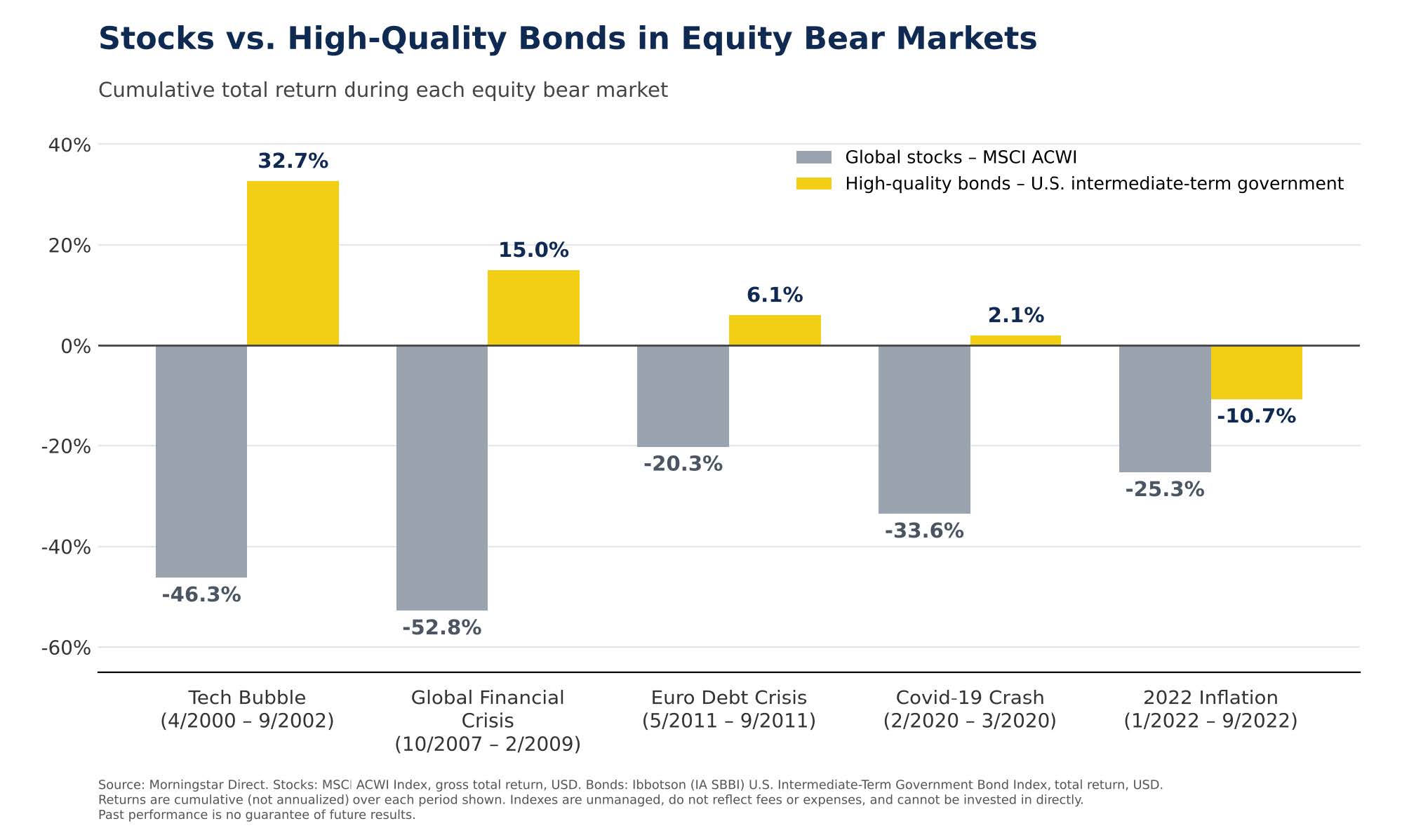
Here are the key takeaways we see from this chart:
- Bonds gained in four of the five periods. High-quality bonds provided positive returns during four of the five large equity bear markets. This means including bonds in a diversified portfolio can help cushion against large losses. This shock absorber is an important factor in building wealth over time.
- 2022 is the exception. Both bonds and stocks fell as rapid interest rate hikes hit both areas of the market. So how well bonds cushion a portfolio can depend on what is driving the stock market decline. Even then, bonds still helped cushion the decline, falling less than half as much as stocks.
Don’t Judge an Investment Solely by Its Most Recent Performance
There’s a behavioral trap hiding in periods like this.
When an asset class performs poorly, our natural tendency is to question why we own it. Conversely, when something performs exceptionally well, we tend to want more of it. That can lead investors to repeatedly buy yesterday’s winners and abandon yesterday’s losers.
But remember that a diversified portfolio works differently.
We don’t expect every part of the portfolio to perform well at the same time. In fact, if every investment in a portfolio always moved in the same direction, there wouldn’t be much diversification at all.
That’s why a bond’s job matters most when it isn’t leading.
So, Do You Still Need Bonds?
For most investors, yes. Here’s why.
Bonds aren’t there to be the exciting part of your portfolio. They’re designed to provide income, help steady things out when stocks are bumpy, and give you a potential source of cash when you need it.
This year has been uncomfortable, but the higher interest rates behind it may mean better returns on the bonds you buy from here.
How We Can Help
At Savant, we don’t try to guess which investments will do well next. We build a plan around your goals and your life..
If this year has you wondering whether your bonds still make sense, reach out to your Savant financial advisor. We’re happy to talk it through.
This is intended for informational purposes only. You should not assume that any discussion or information contained in this document serves as the receipt of, or as a substitute for, personalized investment advice from Savant. Please consult your investment professional regarding your unique situation.
Diversification does not guarantee a profit or protect against loss in declining markets. Investors should consider their individual risk tolerance, investment objectives, and market conditions when making portfolio decisions.
Historical performance results for investment indices, benchmarks, and/or categories have been provided for general informational/comparison purposes only, and generally do not reflect the deduction of transaction and/or custodial charges, the deduction of an investment management fee, nor the impact of taxes, the incurrence of which would have the effect of decreasing historical performance results. It should not be assumed that your account holdings correspond directly to any comparative indices or categories.
 Angela R. Berkosky
Director of Investment Education
CFA®, MBA