
Hot Prices, Higher Rates, and an AI Hangover: Why the Economy Keeps Changing Lanes

What was behind the market’s November swings, and why a diversified plan can help you through them.
November 2026 brought a bumpy stretch for investors. On Nov. 5, the S&P 500 fell 4.4%, its worst day since the April 2025 tariff selloff, and stocks slid again on Nov. 16 as AI chipmakers came under fresh pressure [1][2]. On Nov. 19, a day after the Fed’s meeting minutes signaled more rate hikes were likely, the S&P 500 fell another 2%, its sixth straight daily loss, leaving it about 8% below its Oct. 6 record [15][16]. Add a hotter-than-expected inflation report and a Federal Reserve leaning toward another rate hike, and it’s easy to see why the headlines felt unsettling. The good news? Underneath the noise, the economy is telling a fairly consistent story, and it’s one a diversified portfolio is designed to help weather.
What Was Behind the Volatility
Most of the November selling centered on companies tied to the AI buildout. Investors began questioning how much more these firms can spend and how quickly it will pay off. New chip export limits and concerns about tighter oversight of data centers after the midterm elections added to the pressure, and the Nasdaq slipped into correction territory (a drop of 10% or more from a recent high) on Nov. 5 [1][2].
Interest rates are the other piece of the puzzle. The October Consumer Price Index (CPI), released Nov. 10, showed prices up 0.4% for the month, above the 0.3% economists expected [3]. Core inflation, which excludes food and energy, rose 0.3%, also ahead of forecasts [4]. (The government couldn’t publish an annual rate for October because it didn’t collect October 2025 prices during that year’s shutdown. September’s annual rate was 3.7% [3].) Paired with a strong jobs report, the CPI release left markets pricing a December rate hike as more likely than not [5].
Why the Fed Is Leaning Toward Higher Rates
The Fed raised its target rate in September to a range of 3.75% to 4.00%, its first hike in three years, and held steady at its Oct. 27-28 meeting in a 10-2 vote, with two officials preferring to raise rates right away [6]. The minutes from that meeting, released Nov. 18, show a committee leaning firmly toward higher rates. Almost all officials said further increases would likely be appropriate, and a couple said the committee could consider a larger-than-usual hike at the Dec. 8-9 meeting if inflation data disappoint. Officials described the economy as expanding at a strong pace, with inflation still elevated and broad-based [6].
AI sits right in the middle of the debate. Many officials called the AI buildout a material source of inflation risk, and several worried the investment surge could be excessive. Some officials expect a productivity boost down the road that could help growth without adding to inflation, but they acknowledged real uncertainty about when it arrives [6]. Fed Chair Kevin Warsh has made a similar case: AI may add to inflation in the near term but help bring it down over time [7]. Higher rates also raise the bar for expensive growth stocks, which helps explain why the most richly valued parts of the market fell hardest.
A Strong Economy, a Nervous Market
It’s worth remembering why the Fed is talking about rate hikes in the first place. The economy grew at a 3.4% annual rate in the third quarter of 2026, the fastest pace in a year [8], and employers added 165,000 jobs in October, more than double what economists expected [9]. Business spending on equipment, driven largely by the AI buildout, jumped 20.9%, the fastest pace since 2020 [10].
So why does the market feel so disconnected from that data? Markets are forward-looking. GDP and jobs reports tell us where the economy has been, while stock prices reflect what investors expect next: future earnings, future interest rates, and how much they’re willing to pay today for growth tomorrow. A strong third quarter doesn’t answer the questions investors are focused on, like whether AI spending will pay off on schedule and whether the Fed will raise rates again.
That’s why November’s selloff looks more like investors repricing future growth than a sign the economy is weakening. Consumers and businesses are still spending, even with high rates. They’re just shifting where the money goes, a story I’ll dig into in an upcoming piece on the substitution effect.
Diversification Is Doing Its Job
2026 has been a good reminder of why we diversify. Even with November’s drop, U.S. stocks were still positive for the year as of Nov. 19, and some of the market’s less-loved corners led the way. Value stocks, which many investors wrote off during the long run of tech leadership, far outpaced growth stocks, and international value stocks beat the S&P 500 [11].
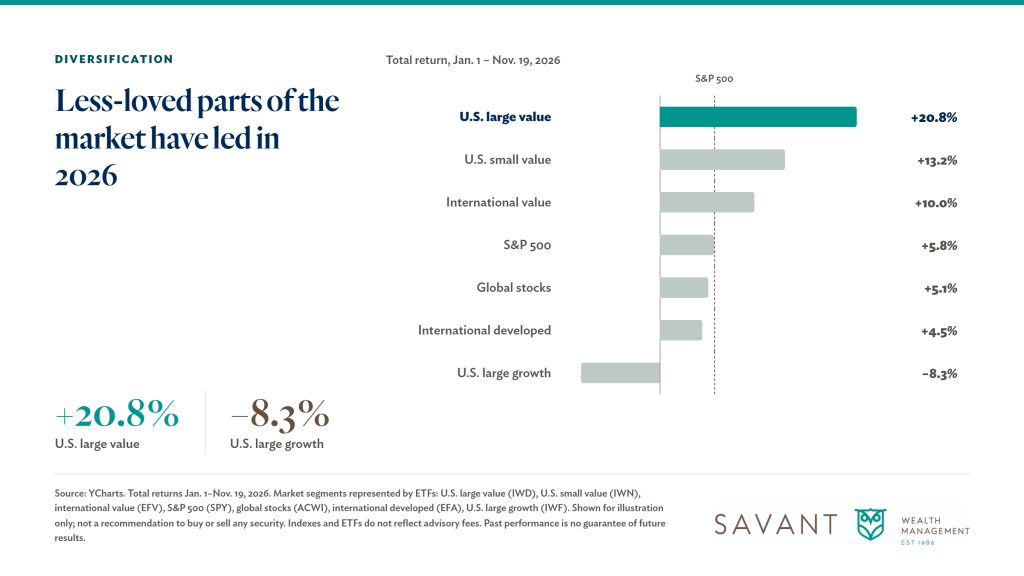
Different parts of the market take turns leading, and no one knows in advance which will be next. That’s why we favor broad diversification, with tilts toward value, quality, and small-company stocks around the world, over betting on any one corner of the market. Overseas, broad international stocks performed roughly in line with the S&P 500 through Nov. 19, so it was value stocks, more than geography alone, that stood out [11].
Volatility Is the Price We Pay for Returns
Pullbacks like this are uncomfortable, but they’re a normal part of investing. Since 1980, the S&P 500 has fallen an average of 14.2% from its high at some point during the year, yet it finished higher in 35 of the 46 calendar years through 2025 [12]. The S&P 500’s deepest drop of 2026 through mid-November, about 9%, was milder than that average [13].
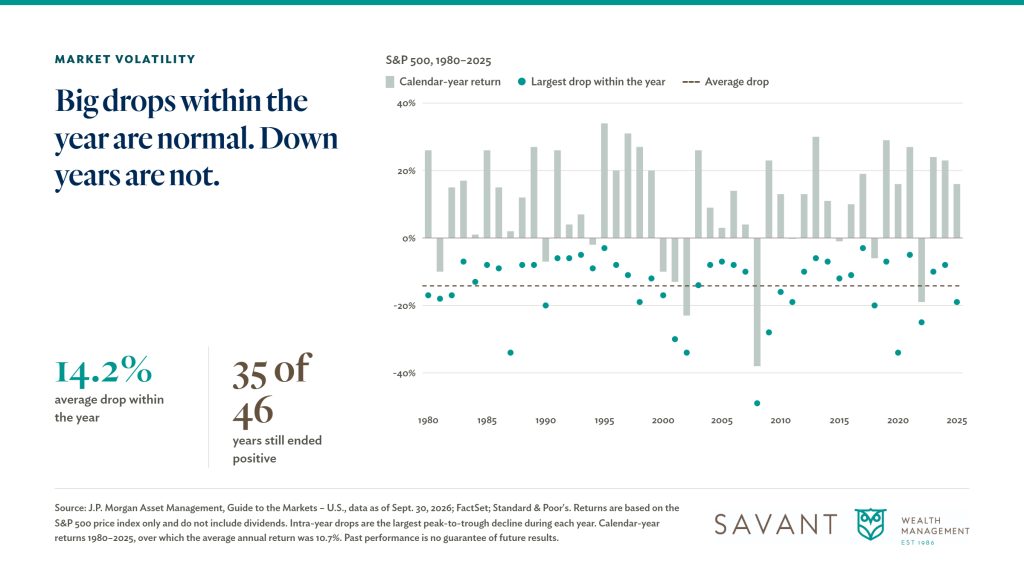
That’s why we don’t try to predict what comes next. Market leadership rotated even within the week of the Nov. 5 selloff, when consumer staples, real estate, and communication services were the only S&P 500 sectors to post gains [14].
- Stick to your plan: Emotion-driven decisions often lead to poor outcomes, and the market’s best days have tended to come close to its worst.
- Rebalance, don’t react: Volatility can create opportunities to bring your portfolio back to its target mix.
- Focus on what you can control: Risk, cost, taxes, and behavior are in your hands. The Fed’s next move isn’t.
A Strong Economy Can Still Have a Bumpy Market
The economy remains strong, and that strength is part of why markets have felt bumpy this fall. Markets are adjusting to hotter inflation, a Fed that may not be done raising rates, and a fresh look at what AI growth is worth. At Savant, we don’t predict. We prepare. Markets favor discipline over speculation, and systems over soothsayers. A diversified, disciplined plan is designed to help you pursue your goals, whatever the Fed decides in December.
If you’d like to talk through how recent volatility affects your portfolio, we’re here to help. Reach out to your Savant financial advisor anytime.
Sources
- Stockwirex: The Nov. 5, 2026 selloff by the numbers
- TheStreet Pro: AI stocks drag the S&P 500 back toward the Nov. 5 lows (Nov. 16, 2026)
- Stock Analysis: U.S. CPI rises in October 2026
- Verified Investing: October 2026 CPI, core and components
- Greenleaf Trust: October CPI and December rate hike expectations
- Federal Reserve: Minutes of the Federal Open Market Committee, Oct. 27–28, 2026 (released Nov. 18, 2026)
- Fast Company: Warsh on AI and inflation
- U.S. Bureau of Economic Analysis: GDP advance estimate, third quarter 2026
- U.S. Bureau of Labor Statistics: The Employment Situation, October 2026
- Reuters via ColoradoBiz: U.S. economy grows on consumer spending and AI investment in the third quarter
- YCharts, total returns Jan. 1–Nov. 19, 2026. Market segments represented by ETFs (IWD, IWN, EFV, SPY, ACWI, EFA, IWF).
- J.P. Morgan Asset Management: Guide to the Markets – U.S., “Annual returns and intra-year declines” (data as of Sept. 30, 2026)
- History of Market: S&P 500 intra-year drawdowns (2026 through Nov. 18)
- Tapeboard: Weekly recap, Nov. 2–6, 2026
- Yahoo Finance: Dow sinks 1,100 points, S&P 500 and Nasdaq fall 2% (Nov. 19, 2026)
- S&P 500 record close of 7,818.93 on Oct. 6, 2026
Past performance is no guarantee of future results. Indexes are unmanaged and cannot be invested in directly.
This is intended for informational purposes only. You should not assume that any discussion or information contained in this document serves as the receipt of, or as a substitute for, personalized investment or tax advice from Savant. Please consult your investment or tax professional regarding your unique situation.
Due to various factors, including changing market conditions and/or applicable laws, the content may no longer be reflective of current opinions or positions. To the extent that a reader has any questions regarding the applicability of any specific issue discussed above to his/her individual situation, he/she is encouraged to consult with the professional advisor of his/her choosing.
Historical performance results for investment indices, benchmarks, and/or categories have been provided for general informational/comparison purposes only, and generally do not reflect the deduction of transaction and/or custodial charges, the deduction of an investment management fee, nor the impact of taxes, the incurrence of which would have the effect of decreasing historical performance results. It should not be assumed that your account holdings correspond directly to any comparative indices or categories.
Diversification does not guarantee a profit or protect against loss in declining markets. Investors should consider their individual risk tolerance, investment objectives, and market conditions when making portfolio decisions.
 Chip Kalousek
Director of Investment Research and Innovation
CFA®